
Artepillin C
The prenylated phenolic acid that distinguishes Brazilian green propolis from European and Asian types. Content is stated per batch on the certificate of analysis.
Brazilian green propolis from Baccharis dracunculifolia, freeze-dried into a water-soluble powder and standardised for Artepillin C and flavonoids. The concentrated form of an ingredient that is usually sold diluted in alcohol.
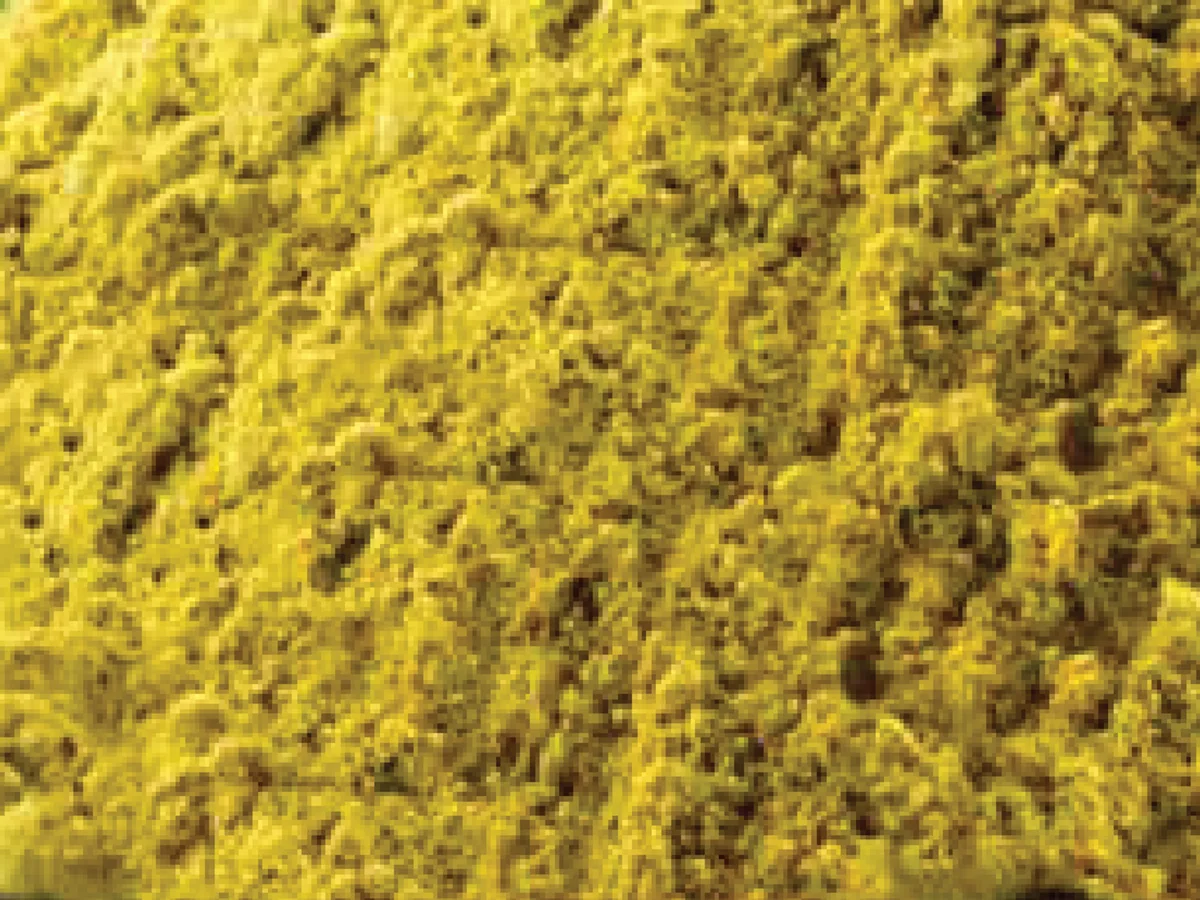
Propolis takes its composition from the plants the bees forage. Green propolis comes from Baccharis dracunculifolia, native to Brazil, which is why this type is produced here and almost nowhere else.
That origin is what puts Artepillin C in the profile — the prenylated phenolic acid used as the marker compound for green propolis, and the reason buyers specify Brazilian material rather than propolis in general.
The prenylated phenolic acid that distinguishes Brazilian green propolis from European and Asian types. Content is stated per batch on the certificate of analysis.
Preserved by low-temperature drying rather than degraded by heat, which is the practical difference between a freeze-dried and a spray-dried extract.
The broader polyphenol fraction carried over from the hydroalcoholic extract, concentrated into a dry, stable powder.
Both arrive as a powder, so the difference is easy to miss on a spec sheet. It shows up in the active content, in how much carrier you are paying for, and in how much volume you move and store.
| Criterio | Liofilizado | Spray-dried |
|---|---|---|
| Proceso de secado | Freeze-drying (sublimation under vacuum) | Spray-drying (hot air) |
| Heat exposure | None — the extract never warms | Inlet air typically above 150 °C |
| Bioactive retention | Higher retention of thermosensitive compounds | Partial loss during thermal drying |
| Volume per kg of active | Up to 50% less volume | Higher volume, often with added carrier |
| Carriers | Not required for the drying process itself | Usually requires maltodextrin or gum arabic |
| Cost profile | Higher processing cost, lower freight and storage cost | Lower processing cost, higher volume to move and store |
Capsules, tablets, sachets and stick packs. The powder form removes the ethanol handling that liquid extracts require.
Water solubility allows cold dispersion without the cloudiness and separation typical of resinous extracts.
Serums, creams and oral care, where a dry standardised input is easier to dose than a hydroalcoholic tincture.
Formulations that need a documented active content and a consistent input from batch to batch.
Active content is determined per batch rather than quoted as a range, so the figure on your specification is the figure in the drum you receive.
See the full ingredient catalog| Botanical origin | Baccharis dracunculifolia |
|---|---|
| Type | Brazilian green propolis |
| Presentation | Polvo liofilizado |
| Solubilidad | Water-soluble |
| Standardisation | Artepillin C and total flavonoids, stated per batch |
| Documentation | Certificate of analysis per batch |
| Almacenamiento | Ambient, dry and protected from light |
| Minimum order | Quoted by volume and destination |
Green propolis comes from Baccharis dracunculifolia, a plant native to Brazil, which is why this type is produced almost exclusively here. Its marker compound is Artepillin C, a prenylated phenolic acid that is present in far lower amounts, or absent, in European poplar propolis and in Asian types.
Spray-drying pushes the extract through hot air, which degrades part of the thermosensitive fraction and usually requires a carrier such as maltodextrin. Freeze-drying removes water by sublimation under vacuum, with no heating and no air contact, so more of the bioactive profile survives and the resulting powder is more concentrated — up to 50% less volume for the same active load.
Yes. It is produced as a water-soluble powder, which is the practical advantage over raw propolis and hydroalcoholic tinctures: it disperses cold, without the ethanol handling, cloudiness and separation that resinous extracts bring to a formulation.
Artepillin C and total flavonoid content are determined per batch and stated on the certificate of analysis, so your formulation and label can be built on a documented figure rather than an estimate.
No. As a dry powder it is shipped and stored at ambient temperature, protected from light and moisture, which removes refrigerated freight from the cost of the ingredient.
A certificate of analysis accompanies each batch. Additional technical documentation for supplier onboarding, customs clearance or regulatory filing is prepared according to the destination market.
Both are quoted after the destination, the required active content and the forecast volume are known, since those three variables drive the price of a standardised extract more than quantity alone.
Yes. The extract can be supplied as a standalone ingredient or incorporated into a custom blend, and we also run full private-label production for brands that prefer a finished product.
Tell us the destination, the Artepillin C content your formulation requires and your expected annual volume. We reply with specification, MOQ and lead time.
Sold as a food and cosmetic ingredient for B2B processing. Nutritional and health claims must be adapted to the regulations of the destination country before sale, and are the responsibility of the brand placing the finished product on the market.