
Conteúdo B2B para equipes de compras, produto e food service. Confirme especificações, dosagem e conformidade nos documentos do lote e nas exigências do seu mercado.
Spray-Dried vs Freeze-Dried Fruit Powder
Neither process wins every application. Spray-dried powders often prioritize throughput and easy reconstitution; freeze-dried powders often prioritize whole-fruit character and premium color.
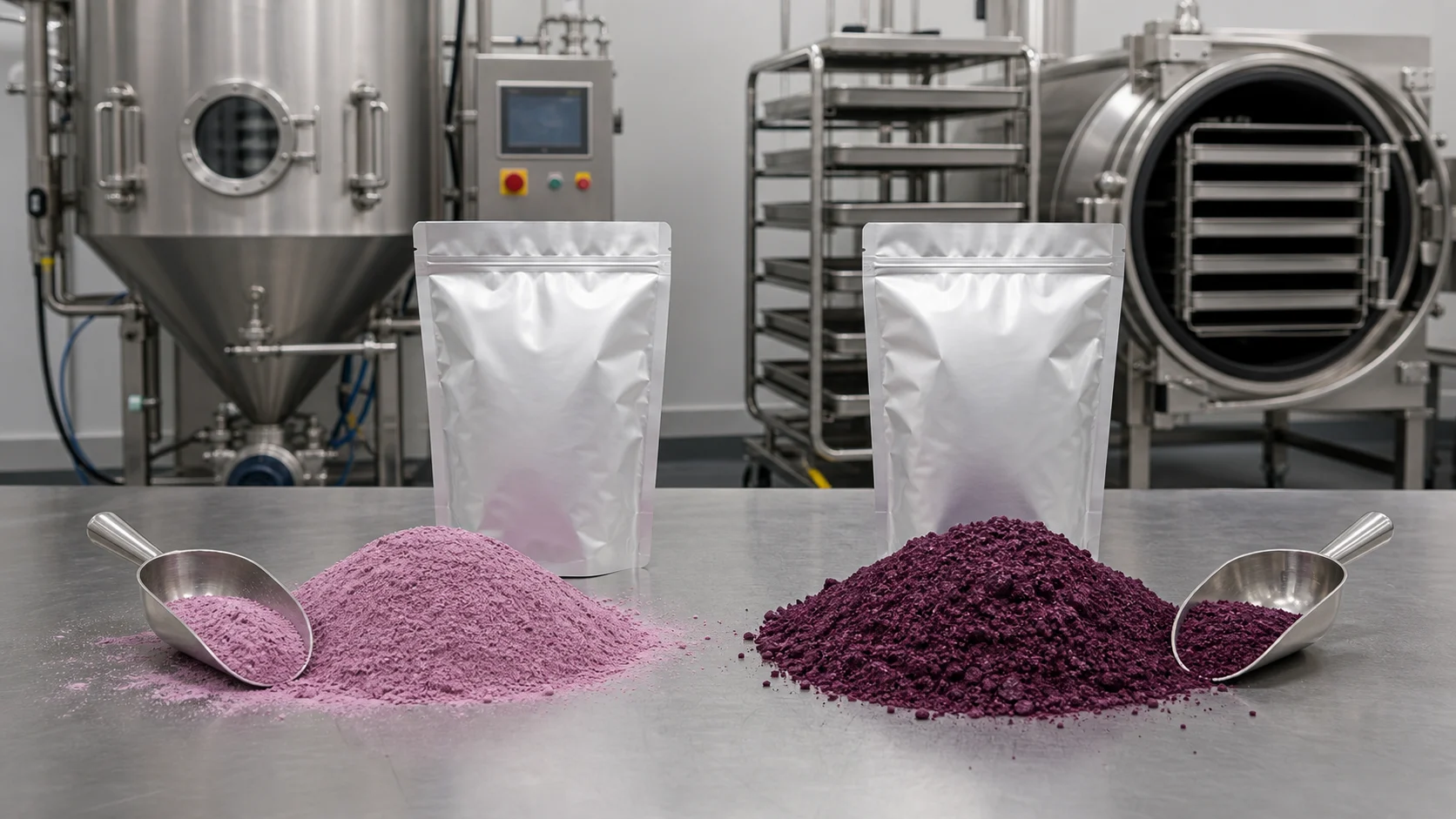
Spray-drying and freeze-drying can both produce useful food ingredients, but they start from different process logic. Spray-drying atomizes a liquid feed into heated air for rapid drying. Freeze-drying freezes the material and removes ice by sublimation under vacuum. The best choice depends on composition, label target, sensory goals, factory process and budget.
Buyer comparison
| Criterion | Spray-Dried | Freeze-dried |
|---|---|---|
| Typical feed | Juice, purée, extract or emulsion | Whole fruit, purée or prepared material |
| Drying environment | Rapid contact with heated air | Frozen material under vacuum |
| Carrier use | Often used for sticky fruit feeds | May be carrier-free or formulated |
| Color and flavor | Depends strongly on heat and carrier | Often selected for premium fruit character |
| Reconstitution | Can be highly soluble with the right carrier | May disperse with visible fruit solids |
| Scale and economics | High-throughput continuous production | Longer batch process and premium cost |
Carriers change the comparison
Sugary and acidic fruit feeds can be sticky during spray-drying, so maltodextrin, gum arabic, starches or other carriers may be used to improve drying yield, flow or reconstitution. That can be technically valuable, but it changes fruit percentage, ingredient declaration, dosage and sensory intensity. Freeze-dried products can also contain carriers, so never infer composition from the process name alone.
When spray-dried can be the better fit
- Instant beverage mixes where fast reconstitution is critical.
- Large-volume formulas with a strict ingredient cost target.
- Encapsulated flavors, oils or extracts that need a carrier system.
- Applications where flow and automated dosing matter more than whole-fruit identity.
When freeze-dried can be the better fit
- Premium products built around recognizable fruit content.
- Applications where vivid natural color and fruit character lead the value proposition.
- Clean-label formulas seeking a carrier-free whole-fruit option.
- Food service, bakery and culinary uses that benefit from flexible dosage.
Do not choose by process name alone
Research comparisons show that carrier type, feed composition and process settings can matter as much as the drying category. A well-designed spray-dried powder can outperform a poorly designed freeze-dried powder in solubility or stability. A carrier-free freeze-dried fruit can outperform a diluted spray-dried formula in color or fruit intensity. Judge the exact specification and sample.
Run a side-by-side buyer test
Compare equal finished-product doses, not equal spoonfuls. Record fruit percentage, ingredient list, color, flavor, wetting, sediment, process loss, shelf behavior and cost per finished unit. The winner is the powder that meets the product brief with the lowest total formulation and operating risk.
Organic freeze-dried açaí powder, exported worldwide.
Compare fruit powder specifications