
Bulk Pitaya (Dragon Fruit) Powder for Food & Beverage Manufacturing
Red-fleshed pitaya is chosen first for color. Its magenta pigments and mild flavor make it a way to add visible, fruit-derived color without a strong flavor shift. Biohacker sources pitaya powder per project and confirms species, origin and specification in the dossier.
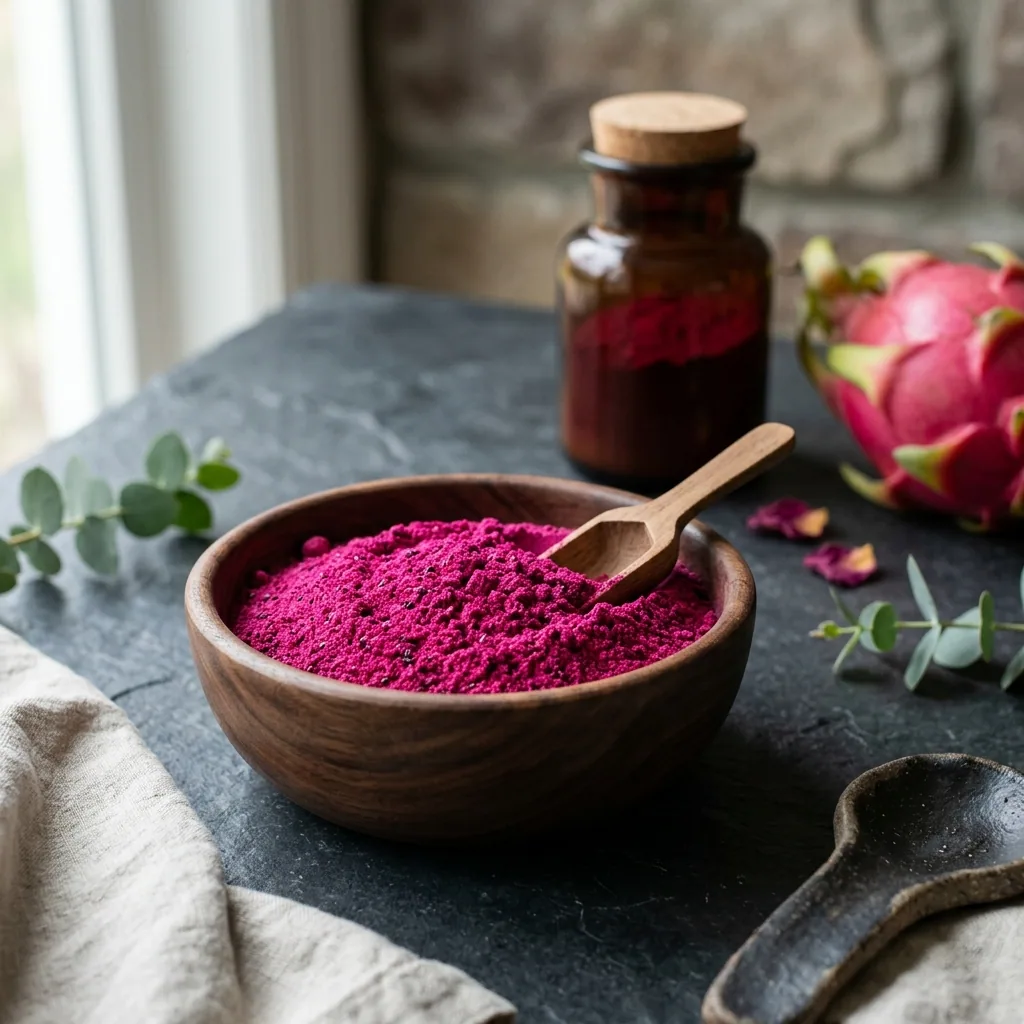
Pitaya (Dragon Fruit) as a manufacturing ingredient
Pitaya is a good example of why the application leads the specification. In a beverage, color stability and dispersion decide the lot. In a bar or chocolate, moisture and particle size do. In a sorbet, it is the color that survives freezing.
Because color depends on the variety of the fruit, we ask which species and flesh color you need before quoting.
Sensory profile: Mild, lightly sweet flavor with low acidity. Red-fleshed fruit gives a vivid magenta to pink color; white-fleshed fruit contributes little color.
Available formats
Formats we list or evaluate for this ingredient. Availability by origin is confirmed per RFQ.
Freeze-Dried Fruit Powder
Dried fruit solids milled to a powder. Ambient storage, close to the fruit in color and aroma.
View detailsSpray-Dried Fruit Powder
Standardized, free-flowing powders, usually with a carrier. Assay and carrier define the specification.
View detailsTypical applications
Functional Beverages
Visible magenta color with a mild tropical flavor.
View detailsSnacks & Bars
Natural color for bars and granola, as powder or, on request, freeze-dried pieces.
View detailsFrozen Desserts & Sorbet
Color for sorbets and frozen bowls; test how the pigment holds through freezing.
View detailsChocolate & Confectionery
Fruit-derived color for coatings and fillings; moisture and heat limits apply.
View detailsTechnical and formulation considerations
Color depends on the flesh
Red-fleshed pitaya contains betalain pigments, which give the magenta color. White-fleshed pitaya is much paler. Confirm the species and flesh color in the specification.
Betalains are sensitive
Heat, light, oxygen and pH can fade betalain color. Test in your own matrix and process, including any pasteurization step and the expected shelf life.
Seeds and particle size
Pitaya seeds are small and edible, so powders can show fine seed specks. If you need a uniform dispersion or a clean look, specify the particle size.
Powder or inclusion
Powder colors a matrix. Freeze-dried pieces add visible fruit to bars and chocolate. Pieces are evaluated on request and are not part of the current catalog.
Specification and commercial information
Scientific name: Hylocereus spp.. Part used: fruit pulp.
- Origin
- Confirmed per origin and lot
- Processing
- Confirmed per origin and lot
- Carrier
- Confirmed per origin and lot
- Specification (moisture, particle size, assay)
- Confirmed per origin and lot
- Packaging
- Confirmed per origin and lot
- Shelf life & storage
- Confirmed per origin and lot
- Organic certification
- Confirmed per origin and lot
- Halal certification
- Confirmed per origin and lot
- Kosher certification
- Confirmed per origin and lot
- Food-safety scheme (HACCP / FSSC / BRCGS)
- Confirmed per origin and lot
- COA & TDS
- Confirmed per origin and lot
- MOQ
- Confirmed per origin and lot
- Lead time
- Confirmed per origin and lot
Specifications, certifications and commercial conditions vary by origin and production lot. Contact us for the current technical dossier.
Documentation you can request
Availability varies by ingredient, origin and production facility.
- Technical data sheet (TDS) for the proposed SKU
- Certificate of analysis (COA), representative or batch
- Microbiology results for the proposed lot
- Ingredient declaration and allergen statement
- Origin and traceability information
- Certificates that apply to the facility (organic, halal, kosher, food safety), where available
Related solutions
Related ingredients
Technical guides
- Freeze-Dried Fruit Powder Applications for Food BrandsFruit powder can add color, flavor and fruit solids across multiple product lines, but each application needs its own hydration and stability test.
- Spray-Dried vs Freeze-Dried Fruit PowderNeither process wins every application. Spray-dried powders often prioritize throughput and easy reconstitution; freeze-dried powders often prioritize whole-fruit character and premium color.
- Choosing Natural Fruit Color Ingredients: Açaí, Pitaya and MaquiFruit powders can color a product purple, pink or red. Whether the color holds depends on the pigment, the pH, the process and the pack.
Pitaya (Dragon Fruit): frequently asked questions
Which pitaya do you source?
The current catalog listing is a red-fleshed pitaya freeze-dried powder. Origin and variety are confirmed in the technical dossier for each lot.
Will the color hold in my product?
Pigment stability depends on pH, heat, light and shelf life. We recommend a trial in your own matrix with a sample from the proposed lot.
Can pitaya replace an artificial color?
It can supply a fruit-derived pink-to-magenta shade in some applications. Whether it is regulated as a food or as a color depends on the market and on how it is produced, so check status with your regulatory team.
Tell us what you are developing with Pitaya (Dragon Fruit)
Share the application, format and volume. We reply within 1 business day with the documentation scope and the next validation step.
Request Ingredient & Specification